
In Toronto, international government officials, leading thinkers, civil society representatives, and think-tank experts gathered for the Global Progress Action Summit.
Held on 8 and 9 May 2026 under the patronage of Canadian Prime Minister Mark Carney, this high-level meeting addressed the core economic and societal challenges facing democratic societies in an era of global crises and democratic recession. The discussions focused on sustainable strategies for economic resilience, social inclusion, and the vital question of how to restore trust in the state’s capacity to act.
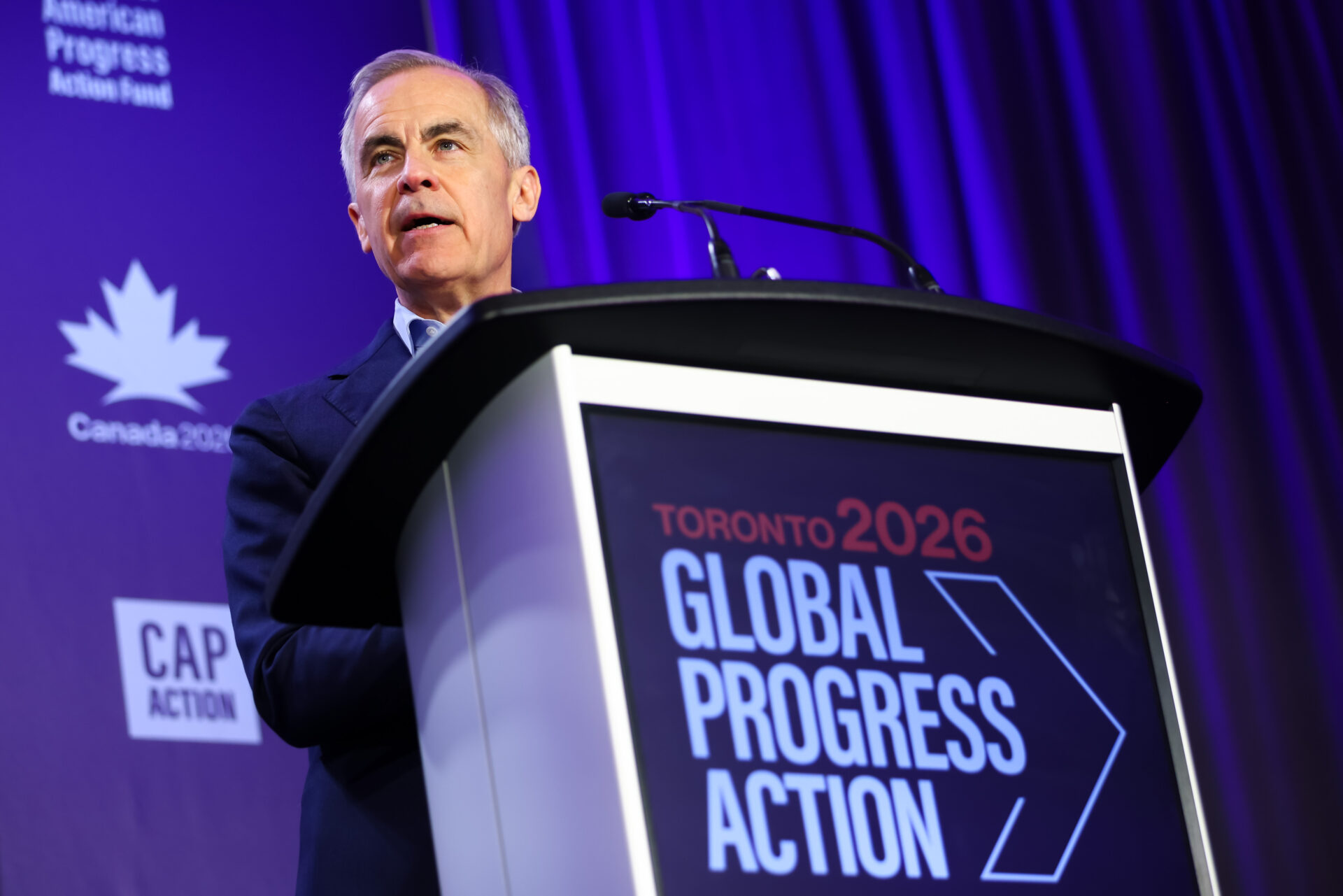
The two-day conference brought together numerous international stakeholders, including Canada’s Minister of Innovation, Science and Industry, Mélanie Joly; former U.S. President Barack Obama; former Prime Minister of Sweden, Magdalena Andersson; and former U.S. Secretary of Transportation, Pete Buttigieg. The German delegation included Federal Minister of Finance, Lars Klingbeil.
The event was jointly organised by the Center for American Progress (CAP) and Canada 2020. Das Progressive Zentrum actively contributed to the policy debate. During a strategy session on future-oriented narratives, Executive Director Dominic Schwickert joined a panel discussion on the conditions required to achieve tangible political change.

Seizing Momentum and Moving Beyond Pure “Deliverism”
The conference built upon and strategically advanced the ongoing international dialogues held in London (autumn 2025) and Barcelona (April 2026). A central talking point was how to respond to the pervasive cost-of-living crisis. In doing so, delegates critically examined the concept of “deliverism” – the technocratic assumption that governments can restore political trust merely by fulfilling policy pledges.
Across the panels and keynotes, it became clear that purely transactional politics often falls short, not least because visible reforms take time and results are not always immediately felt in people’s daily lives. In a world shaped by profound transitions, citizens look for more than isolated measures; they seek direction, credibility, and a sense of collective belonging. To be successful, contemporary politics must look beyond transactional approaches and craft a unifying narrative that inspires confidence and strengthens social cohesion.

The Canadian Model and Economic Resilience
Another key focus was the analysis of fresh approaches to economic policy, particularly the model of the Canadian government under Mark Carney (Click here for his speech). In light of global trade conflicts and protectionist trends, the emphasis was on countering geopolitical risks and the public’s perceived loss of control. Rather than retreating into isolationism, the consensus pointed towards proactive state capacity and targeted development projects.
Under the guiding principle “Building for all – concrete, steel, and code”, speakers outlined the blueprint for a modern industrial policy. This model holistically connects physical infrastructure, social housing, skills development, and technological sovereignty – such as worker-friendly AI applications. The close alignment of economic security and social inclusion with an integrative, community-minded, and progressive patriotism provided valuable impetus for the international debate.
Shortly before the Toronto summit, an op-ed by Florian Ranft titled ‘The centre left is not dead‘ was also published in The Guardian, exploring how the foreign policy approaches of Pedro Sánchez and Mark Carney differ. Read it here.
Next Steps and Knowledge Transfer
The Toronto summit has once again demonstrated the immense value of structured, international exchange in developing viable concepts for today’s economic and social transformations. Deepening the analysis of these approaches and translating these insights into concrete, actionable ideas for the German context remains an ongoing task.