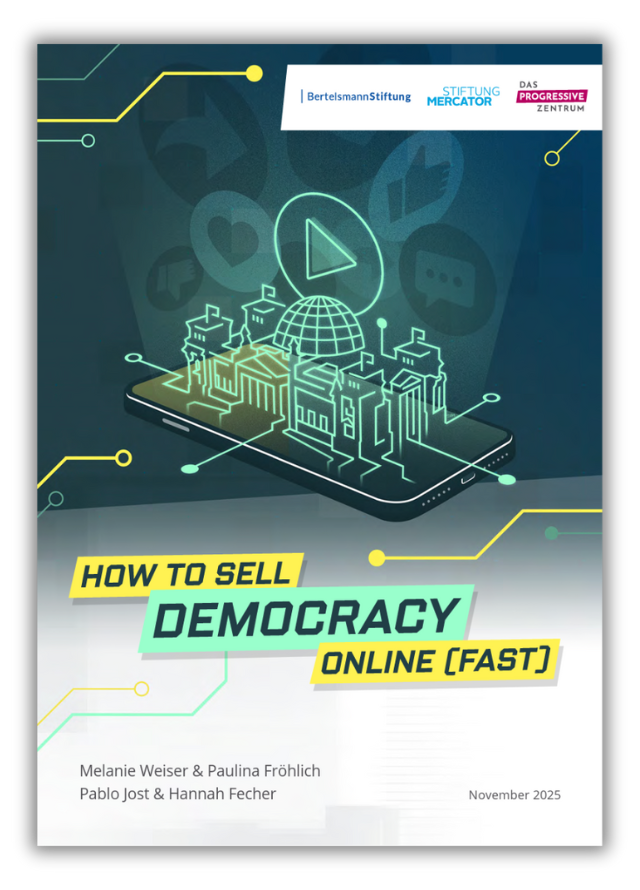
Political content flickers across millions of mobile screens, mainly in the form of clips lasting no more than two minutes, and, whether consumed consciously or unconsciously, has a lasting impact on the political mindset of its recipients. The problem is that, despite growing efforts, moderate democratic actors continue to achieve less success in communication than populist and radical forces. Democratic actors face the important task of learning How to Sell Democracy Online (Fast).
Our study should therefore also be seen as a guide for democratic actors who want to strengthen their social media presence and further develop their media literacy in order to offer young people attractive democratic information and identification opportunities. After all, at a time when democracies are under pressure in many places, teaching democratic values and attitudes is anything but a minor issue. This is not about mere click rates or short-term election advertising, but about building a vibrant democratic culture that also flourishes in the digital space and inspires enthusiasm.
Method
The study ‘How to Sell Democracy Online (Fast)’ examines political communication on social media. It is based on an AI-supported content analysis of around 31,000 short videos by political actors and influencers on Instagram and TikTok between June and December 2024. This was supplemented by a representative online survey, four focus group discussions and a quantitative selection experiment on selection criteria for short videos – each involving young people aged between 16 and 27. This enabled the authors to determine what and how political actors communicate on social media, how young users evaluate this communication, and what expectations they have of it. Based on the results, the authors derive 13 recommendations for successful political communication on short video platforms.
Results
“How to Sell” in a Nutshell


POV: Election Campaign

POV: Election Campaign
The Disregarded
Full Speed Ahead: Progress in 2022+ – A Decade for a Just Transformation
Democratising Democracy: No Transformation without Democratisation
POV: Election Campaign


We develop and debate progressive ideas and bring together leading actors who turn thoughts into action. Our think tank’s goal: making the just transformation a reality. ▸ Learn more