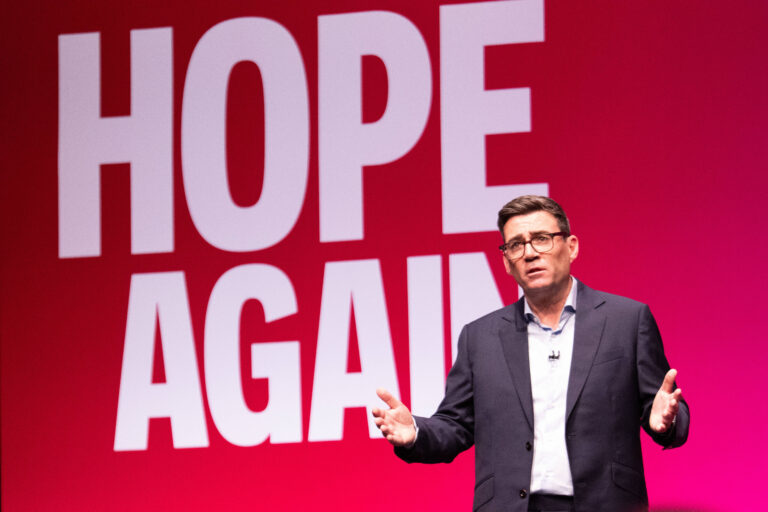
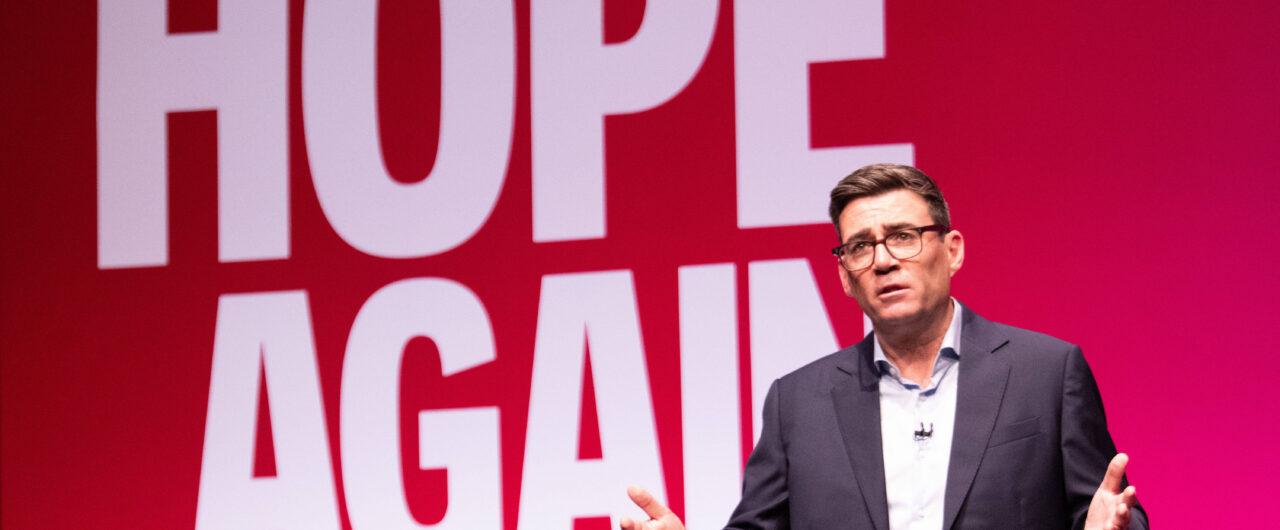
Andy Burnham’s speech at the Labour Party Conference in Liverpool was a masterclass in modern political communication: personal, self-critical, willing to confront conflict. Above all, it had a clear sense of direction. But its most interesting core lies deeper: in the reinterpretation of a populist promise.
Andy Burnham’s speech at the Labour Party Conference in Liverpool was many things. It was his first conference speech as Prime Minister – and therefore his first major programmatic address as head of government. It was personal, statesmanlike and deeply political. Burnham set out a framework for how Britain might find its way out of a state of persistent social, economic and political malaise.
The speech generated an exceptionally positive response among delegates and political commentators. That was by no means inevitable. A year earlier, Keir Starmer had addressed the country and his party at a time when the mood remained sombre and dispirited despite Labour’s decisive election victory in June 2024. Burnham, by contrast, had his audience “on fire” on Tuesday (eleven standing ovations in total!) and the impact extended well beyond Liverpool. He himself modestly summed up his ambition at the end of the speech: “Honesty, ideas and a clear direction.”
And yes: not every one of his diagnoses needs to be shared, nor will every proposed reform work. There are significant unanswered questions about how his major projects would be financed and find political support among Labour MPs. What is nevertheless striking is that a party and government leader is attempting to turn people’s real life problems in times of high cost of living and a state that seems to be dysfunctional in delivering public services into a coherent political project.
First the diagnosis, then the hope
Given empty public coffers, persistently weak economic growth, high inflation, crumbling infrastructure and consistently high levels of support for Reform UK, one might have expected a “tub-thumping” speech with a frontal attack on political opponents and a catalogue of measures for a comprehensive reform programme. But that is not what Burnham delivers. Nor does he offer a generic invocation of optimism. Instead, he delivers an unusually unsparing assessment for a sitting head of government: deindustrialisation, deregulation, privatisation, austerity, Brexit. Britain has been on the wrong path for decades.
Burnham does not simply place the blame on the Conservatives. The state of social care? He explicitly describes it as a failure of his own political generation – “myself included”. He apologises to care workers for the fact that his profession has left them behind for so long. His honesty goes further still: he does not treat Thatcherism simply as a forty-year Conservative episode, but as a political order in which Labour also participated, and whose central premises his own party – and he himself – did not fundamentally challenge for a long time.
That shapes the tone of the entire speech. This is not a classic blame game in which the political opponent is the sole culprit. Instead, Burnham holds his own political tradition responsible. Because the loss of political agency is not a force of nature. Politics itself has surrendered control – over public infrastructure and essential services, regional development, industrial capacity, and ultimately the state’s responsibility to ensure that basic systems function reliably. For Burnham, honesty therefore means more than simply speaking plainly.
This touches on something that extends far beyond Britain: when the train does not run, social care is barely manageable, housing becomes unaffordable, or people in a region feel that decisions about their future are being made elsewhere, an abstract problem of state capacity becomes an everyday personal experience.
Take Back Control – but in a very different way: a Politics of Control
This is precisely why Burnham’s treatment of one of the most powerful political slogans of recent British history is so interesting: “Take back control.” The phrase became the defining slogan of the Brexit campaign. The British right continues to associate “control” with borders, migration and national sovereignty. Burnham does not reject the desire for control. Instead, he asks a different question, thereby reinterpreting the underlying political promise: what, exactly, should people regain control over?
His answer: not primarily other people, but the conditions for a fulfilling, secure and dignified life. In Liverpool, he makes this reversal explicit. The right says “take back control” – yet, in his account, it was precisely its policies that gave control away.
Burnham builds on Manchesterism – the model he developed in Greater Manchester: greater powers for local and regional government, targeted public investment, regional labour-market and training instruments such as the Manchester Baccalaureate, affordable public transport through the Bee Network, efforts to tackle homelessness, cooperation with private actors, and public control where essential infrastructure fails to function. As a result, Manchester has grown significantly faster than the UK average over the past decade and is now also growing faster than London – around 2.8% annual growth compared with 1.3% for the UK and 1.1% for London. The Liverpool speech adds something crucial to this model: a political narrative.
One might describe this approach as a Politics of Control: the state regains the capacity to act in areas that are fundamental to everyday life, while simultaneously devolving power to regions and municipalities, thereby creating the conditions for social cohesion and economic renewal. Control here therefore means neither centralisation nor simply a bigger state, but the ability of a society to shape the conditions of its common life effectively.
This is more than traditional bread-and-butter politics. Burnham talks about electricity bills, housing, buses, social care and pensions. But these issues do not appear as separate items on a shopping list. Individual everyday concerns are presented as collective problems – and from this comes the justification for collective political action. An unaffordable home, an unreliable bus or an overstretched care system become shared responsibilities. Shared does not mean that everyone is affected equally; it means that unequal burdens are nonetheless understood as a collective task. From I to we – without ever resorting to explicit “we” rhetoric.
Political leadership: taking risks on the economy, Europe and at home
This is where Burnham’s approach differs from a politics that presents reform primarily as a necessary, sometimes even unavoidable, burden. Rory Stewart, speaking with Alastair Campbell on the podcast The Rest Is Politics, emphasises that Burnham is deliberately abandoning the risk-averse middle ground with positions such as his stance on Brexit. He sees this as a form of political courage: Burnham is prepared to accept that clear positions may open up political conflict rather than trying to sidestep it communicatively. On pensions, too, Burnham combines his promise of a National Care Service with changes to a politically highly sensitive pension settlement. The difficult choice does not disappear – but it acquires a purpose.
This is central to Burnham’s logic of reform. And it is central to understanding his theory of economic growth. He does not begin with abstract targets such as growth or competitiveness, but with the question of what enables people to live good and productive lives in their everyday surroundings. Good social care, affordable housing, functioning transport and education: from this perspective, these are not merely social expenditures but prerequisites for people to work, participate, take risks and develop trust in the collective endeavour. He actually states something very close to this as his explicit “theory of growth”: retake control of essentials, devolve power to places, then create the conditions for businesses to grow. This is a theory of growth that cannot be found in every text book as it understands the social fabric and functioning of social services places and communities as a necessary condition of economic growth.
Reform is therefore not primarily about dismantling, but about structural rebuilding: a welfare state that provides security, enables people to flourish and strengthens society’s capacity to act. Economic dynamism is not against social infrastructure; social infrastructure is not the opposite of economic dynamism, but one of its preconditions. And at this point, it becomes difficult not to look at Germany through the Burnham lens.
The state is all of us
The connection Burnham makes between political capacity and the common good is interesting: control means being able, together, to regain influence over the conditions of our own lives. There are points of connection in the German debate. Henning Meyer, for example, distinguishes in his concept of a “Capability State” between state capacity, individual capability and “Community Capability”: the relationships, places and institutions in which trust, belonging and collective agency can emerge in the first place: “The state is all of us.”
This points beyond the mere need for a more capable state. Understanding politics solely as an exchange between governments and individual voter groups does not yet create a common project. A democratic society also needs an idea of what connects its members, what they want to preserve or change together – and what they are prepared to take collective responsibility for.
That also includes a calm, positive form of patriotism that can move progressive politics from the defensive to the offensive: national renewal is not defined against others, but rooted in progressive values – through the promise that the country itself can once again work better for everyone.
“Hope comes from honesty.” Perhaps that is the real lesson from Liverpool: political renewal begins where dissatisfaction with the status quo is not translated into resentment, but into a shared project. A project with an honest diagnosis, a clear direction and confidence that change is possible again.


More
Germany’s Fractured Political Landscape: How Can Progressives Rebuild?
The Babler Case: What His Failure Really Reveals