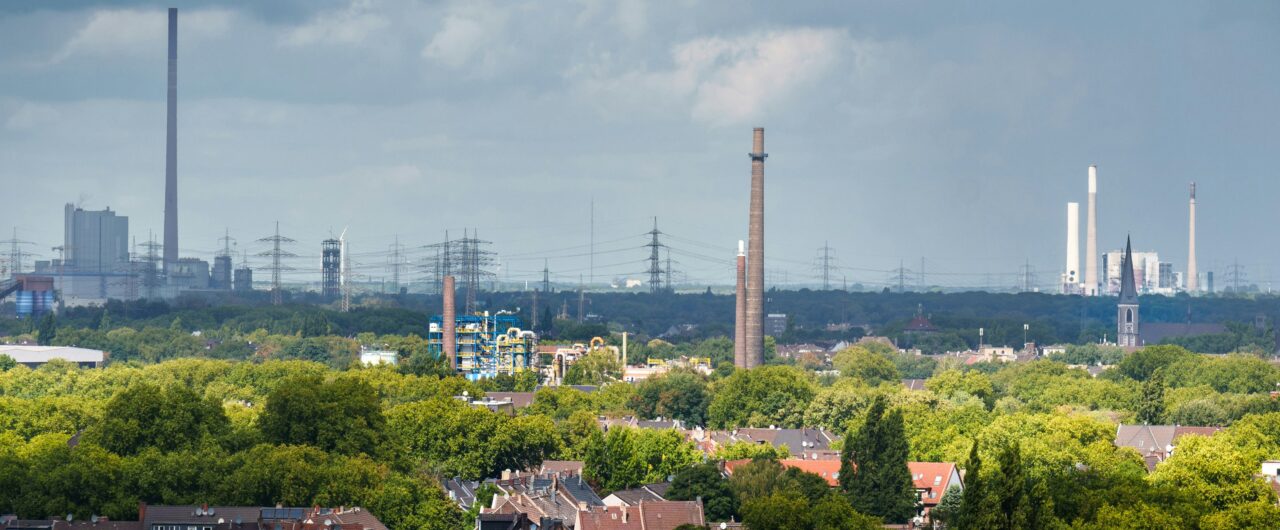
It was a vital moment for the transatlantic community to come together. As participants convened in mid-December 2025, the Transatlantic Dialogue on the Industrial Heartlands – a three-year initiative by Das Progressive Zentrum in collaboration with the Progressive Policy Institute and Georgetown University’s Center for German and European Studies – proved more timely than ever. With the Trump administration’s release of a new national security strategy underpinning the deep rift between the US and European governments, the transatlantic relationship faces an uncertain future.
Whilst this closing conference marked the official end of the project, the dialogue does not stop here. The initiative has yielded answers and findings that contribute significantly to our original goal: creating new opportunities in industrial heartlands. By forging a transatlantic dialogue, exchanging best practices, and developing policy solutions, we have laid the groundwork for a better, greener, and more democratic future in the so-called ‘places that don’t matter’.
Below, we outline the key takeaways and policy recommendations from the conference, exploring how local action can bridge national divides and drive economic renewal.
The Strategic Context: Navigating the ‘3Rs’
The policy landscape in the heartlands is currently dominated by three acute challenges identified by the project’s fellows as the ‘3Rs’: Rearmament, Recarbonisation, and Realignment.
Rearmament: Following Russia’s war of aggression and growing insecurity regarding US foreign policy, defence spending has been rising significantly across Europe. This ‘rearmament moment’ raises critical distributional questions on the stakes heartlands communities can hold in this massive military buildup. How can they leverage their land, industrial infrastructure, and skilled workforce as competitive advantages?
Recarbonisation: A dual-track tension defines the energy transition in these regions. There is a palpable friction between short-term fossil fuel supply needs and long-term climate ambitions. This creates a threat of ‘wobbling’, where the commitment to green transition competes with global competitiveness, risking further entanglement with illiberal energy suppliers which negatively impacts technology leadership.
Realignment: Politically, the heartlands are at a crossroads. Whilst there is a clear alignment between far-right actors across the Atlantic (such as the AfD and US counterparts visiting one another), there is also a bottom-up opportunity for a progressive realignment. While national politics threaten transatlantic unity, cities and regions across the Atlantic are already proving that subnational economic and civic partnerships hold huge potential.
Policy Recommendations: Turning Heartlands into Economic Anchors
To navigate these dynamics, the project’s fellows put forward specific recommendations designed to turn these regions into economic anchors rather than afterthoughts:
- Establish a National Infrastructure Investment Task Force: Hands-on support – improving planning capacity, guiding applications, teaching project management – to empower municipalities lacking planning capacity, fiscal stability, and coordination tools for multi-year transitions.
- Modernise the Workforce through Intergenerational Collaboration: Workforce modernisation must respect local identities and industrial traditions, offering mid-career workers dignity and clear pathways into emerging industries through regional training hubs that unite employers, unions, and educational institutions. Modernised apprenticeships rooted in community trust need to offer practical earn-while-you-learn routes, ultimately making these regions more attractive to the next generation.
- Leverage Defence Industrial Investment: Policymakers should ensure defence spending acts as an economic anchor for these regions. In Eastern Germany, for example, this could be realised via dual-use innovations, drone technology, and battery manufacturing.
- Stick to the Plan, Not the Mood: Regarding industrial transformation, reliability is key. The clear recommendation is to provide realistic schedules that emphasise short-term economic benefits. We must create pragmatic pathways rather than shifting strategy based on the fluctuating political mood.
- Fund Face-to-Face Interaction: There is immense value in supporting direct transatlantic exchange programmes for city planners, unions, chambers of commerce, and vocational schools. Funding programmes that facilitate these human connections enables heartlands to share strategies and collectively strengthen the knowledge-base underpinning their economic futures.
Rebuilding Democratic Infrastructure: Investing in human connection
Beyond hard economics, the conference addressed the deep-seated need for residents to feel rooted, represented, and confident that their region has a future. Amidst challenges such as brain drain, the rise of AI, and political polarisation, the project identified that governing style determines whether people feel hope or alienation.
To strengthen democracy during times of transformation, three core principles were presented:
Firstly, we must invest in dialogue and civic development. Democracy is strongest where people routinely encounter one another in real civic spaces, not online. Human connection serves as essential democratic infrastructure. Consequently, participation must be viewed as a practice over time, not a one-off event.
Secondly, it is crucial to build trust through honest communication. Residents are tired of hearing that money is coming without seeing concrete benefits to their daily lives. Rather than relying on abstract strategy decks or optimistic promises that ignore uncertainty, leaders must communicate specifically about who benefits, what is happening when, and openly admitting to the trade-offs involved.
Finally, trust must be earned through visible action. Real confidence does not come from megaprojects; it comes from the fundamentals. Visible progress on basics – such as repairing streets and maintaining schools – creates the political capital needed to tackle bigger challenges. A successful example from Youngstown, Ohio, demonstrated how block-by-block neighbourhood investment rebuilt credibility, empowering residents to take their community’s future in their own hands.
The Anchors of Stability: Cities and Regions
These policy frameworks are already being put into practice by local leaders. In the short to medium term, cities and regional actors are set to play an even greater role in shaping transatlantic relations. As national governments grapple with geopolitical friction, the conference highlighted that subnational partnerships serve as persistent and reliable transatlantic channels allowing for mutual economic gains and learning exchange.
Participants emphasised that trust is most effectively built locally. Mayors act as crucial diplomats, maintaining connections across the Atlantic even when national dialogues stall. This form of subnational diplomacy is a functional necessity. By engaging in international forums, local leaders are filling the void left by strained national ties, ensuring that the transatlantic alliance remains grounded in shared values.
Shared Challenges, Shared Solutions
Ultimately, the conference revealed profound similarities between the US and Germany. Whether grappling with the ‘3Rs’ or the delicate balance between industrial heritage and economic renewal, the challenges facing a steel town in the American Rust Belt mirror those of a manufacturing hub in the Ruhr Valley. Consequently, there is a tremendous amount we can learn from each other.
As the US and Europe navigate a shifting global economic order, the message from the heartlands is clear: we must combine high-level strategic planning with hyper-local, visible action. By looking towards the heartlands not as problems to be solved, but as places of renewal, we can build the backbone of democratic resilience and prosperity on both sides of the Atlantic.
More
The Babler Case: What His Failure Really Reveals
Hope Comes from Honesty: How Andy Burnham Seeks to Rediscover Political Agency