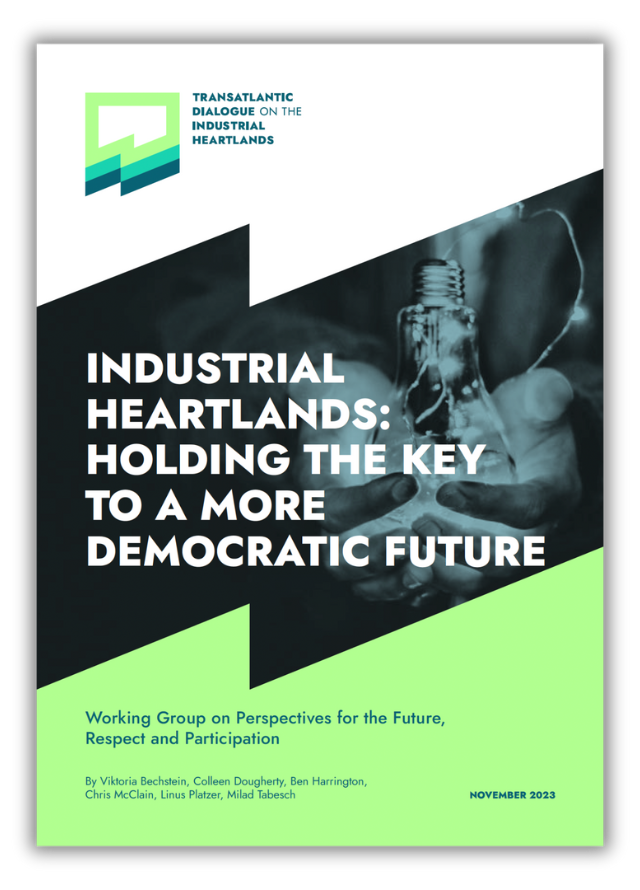
The future of industrial heartlands on both sides of the Atlantic stands at a crossroads. In both Germany and the United States, 2016 was characterised by the ascendance of right-wing politics, a trend exacerbated by the ascendance of right-wing politics bolstered by a perception of abandonment among the constituents of heartland communities.
In this working paper, through our own uniquely developed lenses, we reflect on the current challenges faced by post-industrial heartland communities and regions, spanning three specific areas:
1. Work and Workforce
2. Democratic and Local Participation
3. The Political Future and Elections
For each area, we address what we believe to be the issues as they currently stand, discuss their importance to the future of the industrial heartlands, and work to develop our line of inquiry as a cohort.
Authors
Viktoria Bechstein was a former Project Manager at the Progressive Center. She studied political science in Frankfurt and Lyon and interdisciplinary European studies at the College of Europe in Warsaw. Here she specialized in European economic and social policy, migration and the Europeanization of asylum policy. She gained practical experience at Hessischer Rundfunk, Amnesty International, medico international and in Benin at GIZ.
Colleen Dougherty (she/her) serves as a Research Officer at the Nowak Metro Finance Lab based at Drexel University. Her primary project is Leveraging SSBCI 2.0: Remaking America’s Small Business Capital Landscape.
This paper highlights insights from our journey and proposes a set of principles for local leadership rooted in our experiences as a younger generation of transatlantic leaders navigating structural change. Our recommendations emphasise civic connection and identity, locally grounded communication, and visible delivery.
Ben is currently the Community Development Director for the City of Saline, MI where he guides the city’s housing, planning, zoning, and economic development policies/initiatives.
This paper highlights insights from our journey and proposes a set of principles for local leadership rooted in our experiences as a younger generation of transatlantic leaders navigating structural change. Our recommendations emphasise civic connection and identity, locally grounded communication, and visible delivery.
Founder and president of the McClain Corporation
Christopher B. McClain is a native of Detroit, Michigan. His portfolio of policy expertise includes international trade, economic development, and maritime policy.
Linus is supporting NABU NRW, the largest member-based German environmental organization, in its large regional just transition efforts in the Rhine lignite mining area.
This paper highlights insights from our journey and proposes a set of principles for local leadership rooted in our experiences as a younger generation of transatlantic leaders navigating structural change. Our recommendations emphasise civic connection and identity, locally grounded communication, and visible delivery.
Milad Tabesch holds a Bachelor’s degree in European Studies and Law from Osnabrück and a double Master’s degree in Public Policy and Public Administration from the Hertie School & Columbia University.
This paper highlights insights from our journey and proposes a set of principles for local leadership rooted in our experiences as a younger generation of transatlantic leaders navigating structural change. Our recommendations emphasise civic connection and identity, locally grounded communication, and visible delivery.