
Our transatlantic study tour across Germany’s industrial regions provided firsthand insight into how communities manage structural change while sustaining trust in local institutions. From the Rhineland to Lusatia, we met mayors, civic leaders, and residents testing new approaches to participation, economic development, and community engagement. Their experiences mirrored challenges in U.S. Midwest industrial regions that we experienced during our previous tour of Pittsburgh, Erie, Youngstown, and Detroit in 2024. Discussions centred around the desire to feel rooted, represented, and confident that their region offers a viable future.
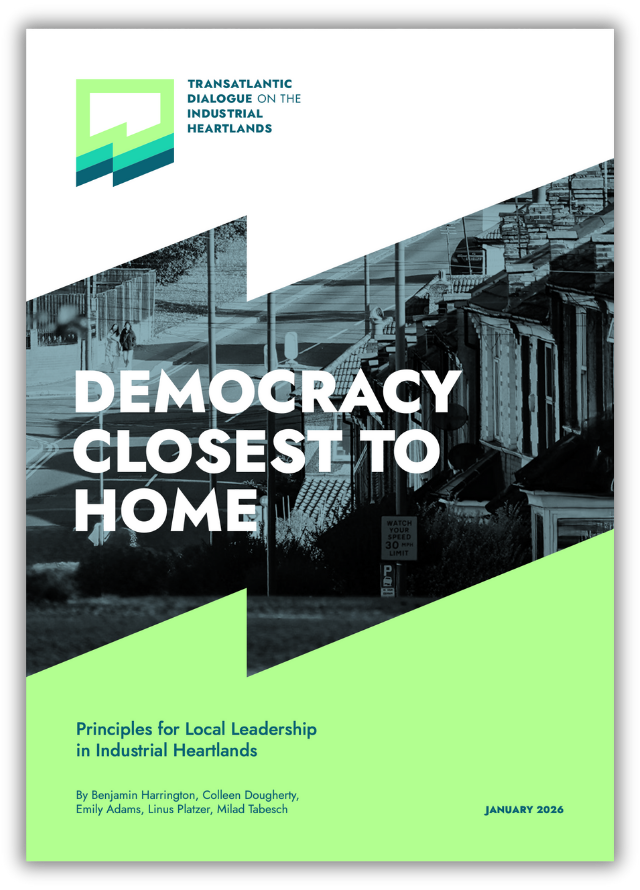
This paper highlights insights from our journey and proposes a set of principles for local leadership rooted in our experiences as a younger generation of transatlantic leaders navigating structural change. Our recommendations emphasise civic connection and identity, locally grounded communication, and visible delivery. They prioritize steady, credible progress over headline projects, so communities can see, understand, and co-own change. These approaches offer practical strategies to strengthen democracy where it is experienced most directly: in local communities.
Abstract
Industrial heartlands in Germany and the United States face intersecting challenges that threaten democratic resilience: political polarisation, demographic decline, economic vulnerability, and eroding institutional trust. These pressures disproportionately affect younger people whilst creating openings for populist movements.
This paper proposes three principles for local leadership. First, invest in civic infrastructure through community organisers and civic hosts who counter social isolation and misinformation. Second, build trust through honest, locally grounded communication that explains transformation policies in accessible terms rather than abstract promises. Third, earn trust through visible action on everyday priorities – maintained infrastructure and tangible neighbourhood improvements – not distant mega-projects alone.
Successful transformation requires that residents experience change as understandable, participatory, and beneficial in daily life. When communities can see change, shape it, and trust those leading it, they sustain confidence in democratic institutions during profound transition.
Principles for Local Leadership in short
Principle 1: Invest in Dialogue and Civic Development
Democracy is strongest where people regularly encounter one another, making human connection the most enduring infrastructure we can build. To counter the feedback loop between social isolation and misinformation, leaders must invest in “democratic hosts” and everyday spaces of dialogue that cultivate trust across divides. Strengthening civic life is therefore not just a defensive strategy, but an affirmative investment in a community’s capacity to solve problems together.
Principle 2: Build Trust Through Honest and Consistent Communication
While federal structural policies provide extensive frameworks for transformation, residents often perceive the intended benefits as unclear or intangible, creating a dangerous disconnect between national ambition and local reality. This gap is particularly acute for young people, who hear abstract promises of “opportunity” while facing precarious employment and uncertain futures. To restore confidence and counter polarisation, leaders must prioritise clear, honest communication that acknowledges constraints and engages communities, rather than relying on overoptimistic narratives that ultimately undermine trust.
Principle 3: Earn Trust Through Visible Action
Public trust is not earned through grand declarations but through consistent, visible progress on the fundamentals that turn distant goals into lived experiences. Rather than focusing on mega-projects that often overlook local realities, leaders should support “homecomers” and community initiatives to deliver steady, incremental renewal block by block. Ultimately, trust returns through the reliability people witness in their daily lives, proving that government can deliver and that their communities have a future worth investing in.
About the Working Group
The Industrial Heartlands Fellows Working Group on Climate, Work, and Innovation comprises seven young professionals from the United States and Germany. As part of the “Transatlantic Dialogue on the Industrial Heartlands” project, they traveled to the US Midwest as well as West and East Germany over the past 24 months, engaging with numerous organisations and individuals who are deeply involved in shaping the future of industrial heartlands.
Their engagements provided valuable insights into the challenges and opportunities in these regions. This policy brief reflects on their findings, and aims to provide actionable recommendations for policymakers and change makers in both the United States and Germany. This transatlantic initiative underscores the importance of collaborative efforts in addressing contemporary challenges in our societies.
Authors

Industrial heartlands: holding the key to a more democratic future

Industrial heartlands: holding the key to a more democratic future


Industrial heartlands: holding the key to a more democratic future

Industrial heartlands: holding the key to a more democratic future

We develop and debate progressive ideas and bring together leading actors who turn thoughts into action. Our think tank’s goal: making the just transformation a reality. ▸ Learn more